
Going down, and the first surprises
Drilling that deep is slow, heavy work. The drill bit sits at the end of a string of steel pipe that grows miles long, grinding through solid rock, while a thick fluid called drilling mud is pumped down to cool the bit and carry the crushed rock back up. Year after year the hole went deeper. On June 6, 1979, it passed 9,583 meters, about 31,440 feet: the depth of a well in Oklahoma that had been the deepest hole on Earth. The record now belonged to Kola.
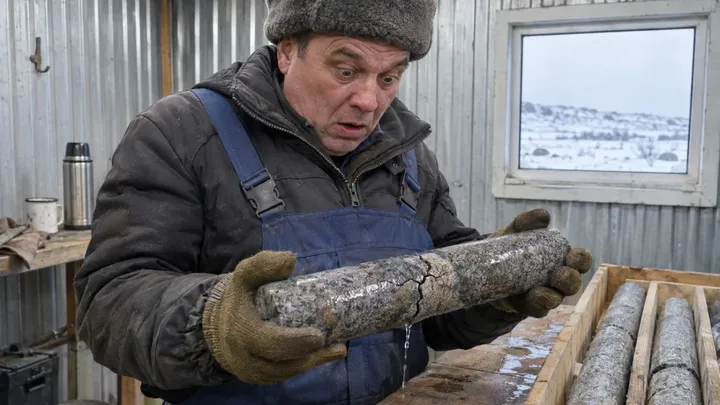
Then the surprises began. Earthquake waves had suggested that about 7 kilometers (4.3 miles) down, the granite would give way to a heavier rock called basalt. The basalt never came. The drill found more granite instead, much of which was cracked, and the cracks held water. Between about 3 and 6 kilometers down, roughly 2 to 4 miles, the rock was soaked, with the water trapped under a layer of rock it could not pass through. Nobody had expected free water that deep.
About 6 kilometers (3.7 miles) down, the rock held something even stranger: microscopic fossils of plankton, tiny living things that once drifted in ancient water, now locked in stone miles below the surface. And the drilling mud that came back up looked as if it were boiling. It was full of hydrogen gas, far more than anyone had predicted. The deeper they went, the stranger it got. On the next page: what was waiting past 12 kilometers, and why it stopped them.