
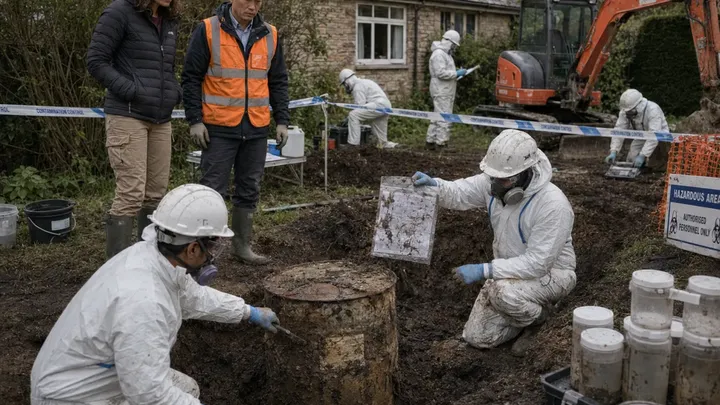
“No,” Mary told the representative. “You do not get to bury this twice.” She ended the call and gave the number to Daniel. Before dawn, specialists treated the colonies with a slow-acting bait to prevent swarming. Excavation crews then removed the surface soil in sealed layers. Mary watched as they approached the first row of drums.
The ground gave way without warning. A worker dropped to one knee as a hidden chamber collapsed, and fire ants poured over his boots. “Back to the clean zone!” Daniel ordered. The crew retreated through a decontamination spray while another team contained the swarm. Nobody was seriously hurt, but the damaged soil had shifted, exposing the side of a corroded drum.
Part of a Calder label remained beneath the rust. Inside, the chemical residue matched the blue absorbent and the company’s archived formulas. Beneath a second drum, workers found a plastic document sleeve protected by compacted clay. It contained a disposal ledger with dates, truck numbers, chemical quantities, and managers’ initials. Arthur Bell’s nighttime journeys appeared on several pages. The final entry recorded another delivery after the factory officially closed. Its destination was not Mary’s garden. A hand-drawn arrow pointed towards the playing field.