
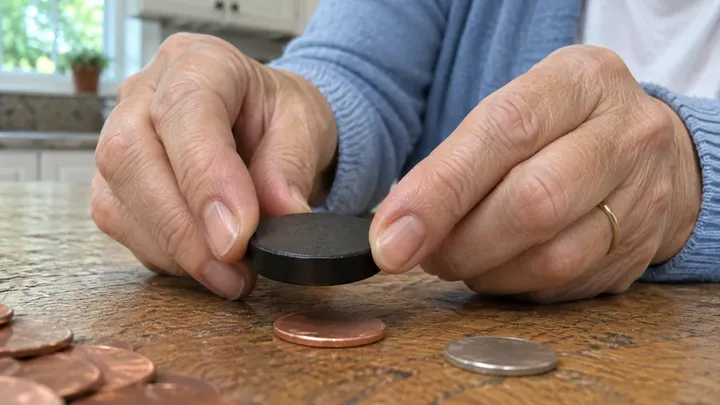
The 1943 penny and the magnet test
During World War II, the country needed copper for ammunition. So in 1943, the Mint made pennies out of zinc-coated steel instead. They look silvery grey, and millions of them were made, so an ordinary 1943 steel penny is common. But a few pennies that year were struck by mistake on leftover bronze blanks, the usual copper-colored metal, still sitting in the machines from 1942. Experts believe only about 40 of these 1943 bronze pennies were ever made.
They are some of the most famous mistakes in American coins. The only known 1943 bronze penny from the Denver Mint, marked with a small D under the date, has sold for $1.7 million. Another one turned up in 1947 in the change a 16-year-old boy got at his school cafeteria in Massachusetts. He kept it for the rest of his life, and in 2019 it sold at auction for $204,000.
Here is the test. Hold a magnet to any copper-colored 1943 penny. Steel sticks; bronze does not. If yours sticks, it is a steel cent plated with copper, a common fake. If it doesn't stick, look closely at the 3: many fakes are 1948 pennies with the 8 filed down to look like a 3. A kitchen scale that reads to a tenth of a gram helps too: bronze cents weigh about 3.1 grams, steel ones about 2.7. On the next page: three pennies where everything looks doubled.