
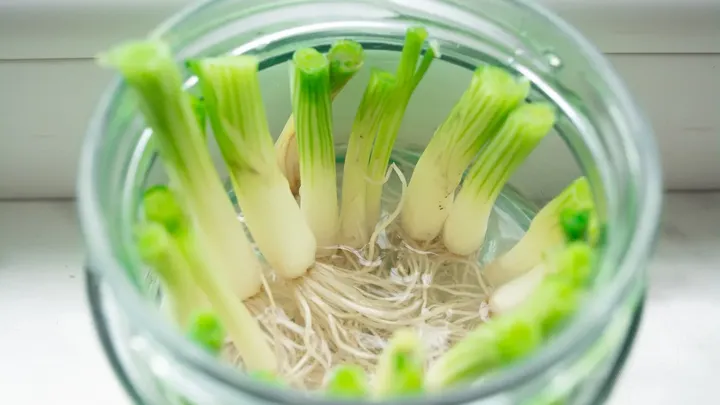
The white end of a bunch of spring onions, roots still attached, usually ends up in the trash. But stand it in a glass with a little water on the windowsill, and it can start sending up fresh green shoots within days.
According to the University of Illinois Extension, spring onions are among the easiest vegetables to regrow from kitchen scraps. Some gardeners report seeing new shoots after just three days, with enough growth to snip within a week.
German gardening magazine Mein schöner Garten recommends trying the same technique with celery, Chinese cabbage and basil.
However, there's an important difference: some scraps produce useful new greens, while others never grow back into the vegetables you originally bought.
Spring onions: The easiest vegetable to regrow
Spring onions, also called green onions or scallions, are an excellent starting point because their white bases can quickly produce new green shoots.
The method is surprisingly straightforward.
According to Stop Food Waste, you should save the bottom 1 to 2 inches (2.5 to 5 cm) of each spring onion, keeping the roots attached.
Place the white ends upright in a small glass and add enough water to cover the roots and lower part of the base. Keep the upper portion above the water.
Put the glass on a bright windowsill and replace the water every one or two days.
The Farmers' Almanac reports that new shoots can appear in approximately three days, with greens ready to harvest after five to seven days. These are estimates rather than guaranteed results.
Once the shoots are long enough, simply snip off what you need for salads, soups or scrambled eggs.
For longer-lasting growth, transfer the rooted bases into a pot of soil.
Celery grows back too, but don't expect another bunch
Celery is another popular choice, although the results are quite different.
Cut the stalks approximately 2 inches (5 cm) above the base, keeping the center intact. Place the stump in a shallow bowl with enough water to cover its lower portion.
Within days, small green leaves may begin emerging from the middle.
However, gardening website Gardenary explains that celery regrows from its central heart. The original stalks won't grow back, and any new stalks are unlikely to match the thick, crunchy ones from the supermarket.
That's why Gardenary considers celery less worthwhile to regrow.
Still, the tender leaves can be useful for flavoring soups, stews and homemade vegetable stock.
Which other vegetable scraps grow in water?
Spring onions and celery aren't your only options.
According to Mein schöner Garten, several other kitchen leftovers can produce new growth:
- Chinese cabbage and bok choy: Keep the bottom intact to encourage new leaves from the center.
- Romaine lettuce: The base can produce a small amount of fresh foliage, although it won't replace an entire lettuce head.
- Leeks: Rooted bases can send up new green shoots.
- Basil: Place a healthy stem cutting in water until roots develop, then transfer it into soil.
- Carrot tops: They can produce leafy greens, but won't grow another carrot.
The important thing is knowing what to expect. Most kitchen scraps provide modest amounts of greenery rather than an entirely new vegetable.
How to prevent your vegetable scraps from turning slimy
One common mistake is adding too much water.
For most scraps, approximately 1 inch (2.5 cm) is sufficient, although larger bases may need less or more depending on the container.
Keep the upper leaves and cut surfaces out of the water whenever possible.
Change the water every one or two days, especially if it becomes cloudy. A clean container and fresh water help prevent unpleasant smells and rotting.
Choose a bright spot away from excessive heat. If a scrap becomes moldy, develops a rotten smell or starts breaking down, discard it and wash the container.
Why this is worth trying during winter
November and December aren't exactly prime gardening months, but a kitchen windowsill can still provide a little greenery.
Growth may be slower during short winter days than the springtime estimates suggested in gardening guides. A bright window helps, although you shouldn't expect every scrap to sprout successfully.
It's also an easy project to try with grandchildren. Children can watch the roots develop and measure how quickly the shoots grow.
Best of all, there's little preparation involved.
The next time you use spring onions for dinner, save the rooted white ends. With a glass of water and a little patience, you may have fresh green garnish for another meal within a week.