
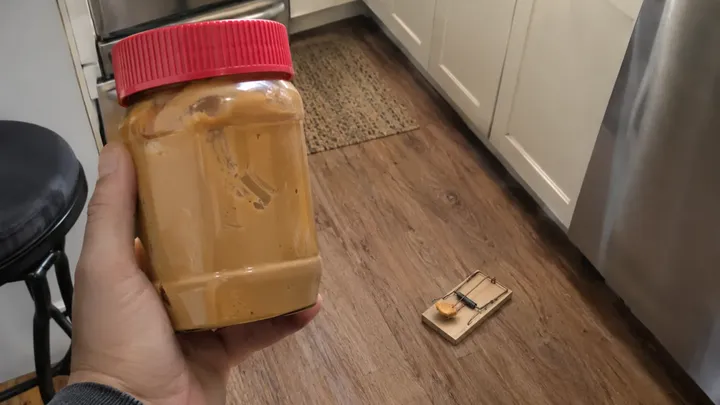
Finding rat droppings in your shed or spotting a rat near your bird feeder is never a pleasant surprise. Peanut butter is a popular choice of bait for rat traps, but Australian researchers have discovered that it might also be useful when rats can't actually eat it.
Researchers at the University of Sydney found that placing inaccessible peanut butter outside a tunnel containing plain white bread increased rat entries by 83 percent. Interestingly, the idea behind the experiment comes from a marketing tactic that retailers use to influence our shopping decisions.
A little peanut butter just out of reach
Professor Peter Banks, senior research officer Jenna Bytheway, and their colleagues set up 226 tracking stations in wooded areas around Sydney, Australia. Using motion-activated cameras, they observed how wild black rats responded to different types of bait.
Some tunnels contained plain white bread, while others contained strawberry jam sandwiches or no food at all. The researchers also placed small steel containers holding a mixture of peanut butter and oats outside some tunnel entrances. The mesh lids allowed the rats to smell the food without being able to eat it.
The results, published in the Journal of Applied Ecology, revealed that the proportion of bread-baited tunnels that rats entered increased by 83 percent when the inaccessible treat was present.
A marketing trick that works on rats
Imagine you're shopping online and find a television you really like, only to discover that it's sold out. Suddenly, a less expensive model that you previously overlooked might seem more appealing.
Behavioral economists call this unavailable option a phantom decoy. The researchers believe something similar may have happened with the rats. Unable to obtain their preferred food, the animals appeared more willing to settle for ordinary bread.
Interestingly, the peanut butter didn't appear to attract additional rats to the stations. Instead, it seemed to influence what the animals did once they arrived. There was also no significant improvement when the tunnels already contained appealing bait, such as jam sandwiches.
Could this help you catch rats at home?
Speaking to ABC News, Professor Banks suggested that an ordinary chocolate shaker of the kind used to dust cappuccinos could be used to recreate the setup.
However, there's an important distinction. The experiment measured how readily rats entered monitoring tunnels, not how many were caught or killed in functioning traps.
The researchers also studied black rats, sometimes called roof rats, which are particularly good climbers. Whether brown rats, also known as Norway rats, would respond in the same way remains untested.
Nevertheless, finding ways to improve traps without relying on poison could be beneficial. Although certain rat poisons remain available to American households, the Environmental Protection Agency warns that these products must be used carefully to protect people, pets, and wildlife.
How to position a rat trap correctly
If you've already tried catching rats without success, the problem might be where you've placed your traps or how quickly you've set them.
The Centers for Disease Control and Prevention (CDC) recommends the following:
- Position traps along walls where you've noticed rat activity, with the baited end facing the wall.
- Leave baited traps unset for several days to help wary rats become accustomed to them.
- Use a small amount of peanut butter as bait rather than a generous spoonful.
- Keep traps inaccessible to children, pets and other animals, using a protective enclosure where appropriate.
- Inspect traps daily and wear protective gloves when handling dead rodents.
If you're curious about the Australian experiment, you could consider placing a securely closed, mesh-lidded container of peanut butter beside the entrance to an enclosed rat trap. Just remember that its effectiveness with household traps hasn't been established.
Finally, remove whatever might be attracting rats in the first place. Fallen birdseed, spilled chicken feed, accessible food scraps, and poorly secured garbage cans can all provide an easy meal. Without addressing these food sources, even a successful trap may offer only temporary relief.