
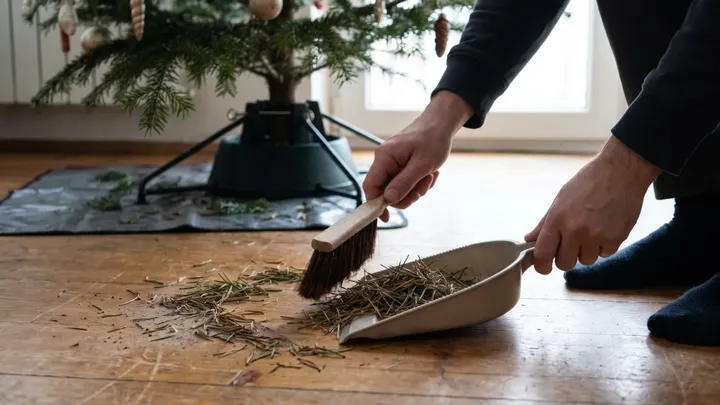
A real Christmas tree can look perfectly healthy when you bring it home, only to start dropping needles long before Christmas Day. You water it, keep an eye on the branches and assume you're doing everything right. Yet by the end of December, the floor is covered in needles and the tree looks rather worse for wear.
What many people don't realise is that the way a tree is handled in the first few hours after being cut can make a big difference to how well it lasts indoors. Tree growers and university experts have some straightforward advice, and one small job at the base of the trunk is particularly important.
Why tree growers saw off a slice of the trunk
Once a Christmas tree has been cut, the exposed end of its trunk gradually loses its ability to take up water efficiently. Air enters the water-conducting tissue, and the cut surface can begin to seal. A tree that's been standing for several hours may therefore struggle to absorb enough water, even when its stand is full.
The National Christmas Tree Association says this can start after around 3–6 hours. Other advice gives a slightly longer window: Durham County Master Gardeners and Sugar Pines Farm say most species can still take up water for around 6–8 hours. Penn State says a tree cut within the previous 12 hours generally doesn't need another cut.
If your tree has been sitting around for longer, saw a thin slice from the bottom before placing it in the stand. Around 6–13 mm is enough. Make the cut straight across rather than at an angle or in a V-shape, so the tree sits securely and the whole cut surface can remain underwater.
Don't shave the sides of the trunk to make it fit, either. The outer layers are particularly important for water uptake.
How much water does a Christmas tree need?
More than you might expect. According to the National Christmas Tree Association, a tree can use up to one US quart (about 0.95 litres) of water per day for every 2.5 cm of trunk diameter. It can take up especially large amounts during its first week indoors.
That means the stand needs a decent-sized reservoir. Penn State recommends a capacity of at least one US gallon, or around 3.8 litres, for most trees. Check the water level every day and top it up whenever necessary.
One detail is easy to overlook: the water must cover the cut end of the trunk. There can still be water in the stand even when the base of the tree is no longer submerged. If it dries out, the cut surface can seal again and reduce water uptake.
Do additives and other Christmas tree tricks help?
You might have heard that adding sugar, aspirin, bleach or a commercial preservative will help your tree stay fresh. But the advice from Penn State and the National Christmas Tree Association is clear: plain tap water is all you need.
Water-holding gels aren't recommended either. Penn State warns that they can actually reduce the water available to the tree. Drilling holes into the base of the trunk won't improve water uptake, and special drip-feed devices are less effective than a traditional stand that holds water.
There is some disagreement about water temperature. The National Christmas Tree Association says hot tap water can increase uptake in some trees, while Penn State says the temperature makes no difference. The simplest approach is to use ordinary clean tap water and focus on keeping the reservoir topped up.
A few more things that help your tree last
If you can't put the tree in its stand straight away, place the freshly cut trunk in a bucket of water and keep it somewhere cool and shaded. Once it's indoors, position it away from radiators, fireplaces, heaters and direct sunlight. These sources of heat speed up drying.
Keep checking the needles, too. If they become dry and brittle, or fall off easily when touched, the tree may be past its best. Penn State and Durham County Master Gardeners advise removing a very dry tree from the house.
And one final safety reminder: never burn any part of a Christmas tree in a wood stove or fireplace. It's not a suitable way to dispose of it, even after the decorations have come down.