
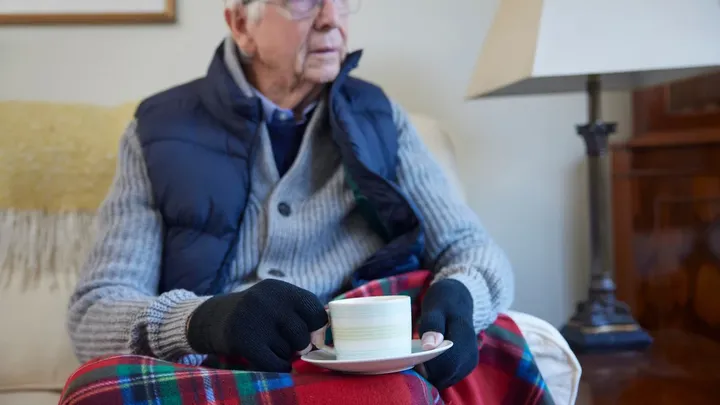
Sitting under a blanket while the rest of the family is perfectly comfortable is a familiar experience for many people over 60. And new research suggests there may be a biological reason why older adults feel the cold more intensely. The findings fit with what doctors already know: our bodies gradually become less efficient at producing and retaining heat as we grow older.
What scientists discovered about the body's heat-producing fat
Scientists at City of Hope in California have discovered that a special type of body fat responsible for producing heat becomes slower to respond as we age. Their findings, published in the scientific journal Nature, could help explain why a room that once felt comfortable suddenly seems chilly.
The study, published on November 11, 2026, was conducted mostly in mice and focused on brown fat, also known as thermogenic fat. Unlike ordinary white fat, which stores energy, brown fat burns energy to generate warmth. Researchers discovered that signals from nerves and immune cells help control how much heat this fat produces.
In younger mice, brown fat cells could switch between low and high heat production when temperatures changed. In older mice, however, this process became less flexible. The cells could still produce additional heat, but they took longer to respond to cold. This made it harder for the older animals to maintain their body temperature.
The researchers also examined human fat tissue and found similar patterns of active and less-active cells. Qiong "Annabel" Wang, a researcher at City of Hope, explained that thermogenic fat also burns glucose and fat, and its activity tends to decline with age.
Although researchers partially restored heat production in older mice using a drug called mifepristone, the drug is not a treatment for feeling cold. Its effects on multiple body systems make further research essential.
Why older people often feel colder
Brown fat isn't the only explanation.
Dr. Elise Dallas, a GP at London General Practice, explained in an interview published by RTÉ that several age-related changes make staying warm more difficult.
One important factor is muscle loss. Muscles generate heat, even during ordinary daily activities. As muscle mass gradually decreases with age, the body produces less warmth.
The layer of fat beneath the skin may also become thinner, reducing natural insulation.
Meanwhile, changes in metabolism, hormones and the body's temperature-regulating system can make it harder to respond quickly to cold.
Certain medications and medical conditions, including an underactive thyroid, anemia and diabetes, can also increase sensitivity to lower temperatures.
When feeling cold could signal something else
Feeling chilly more often isn't necessarily a cause for concern. However, a noticeable change shouldn't automatically be dismissed as part of aging.
If you suddenly feel much colder than usual, particularly alongside unusual tiredness, weight changes or breathlessness, it's worth speaking with your doctor.
A thyroid problem or anemia, for example, may need investigating.
Cold exposure also matters for other reasons. According to the British Met Office, older adults face greater risks from prolonged cold, including cardiovascular problems, worsening arthritis and falls. Severe cold can even cause hypothermia indoors.
What temperature should older people keep their homes?
British health guidance recommends keeping the home at at least 18°C (64°F), particularly for people aged 65 and older.
The Met Office also advises maintaining a bedroom temperature of at least 18°C overnight for older adults and people with existing health conditions.
Some UK council guidance recommends keeping living rooms between 18°C and 21°C (64–70°F).
If heating the entire house is too expensive, concentrating on keeping the main living area warm can help. Other useful habits include:
- Wearing several layers of clothing.
- Having regular hot meals and drinks.
- Moving around regularly, if physically able.
- Closing curtains in the evening to reduce heat loss.
- Warming the bedroom before going to sleep.
Advice on turning the thermostat down to 15°C overnight to save energy shouldn't automatically be applied to vulnerable older adults.
For people over 65, staying comfortably and safely warm is more important than following a general energy-saving rule.