
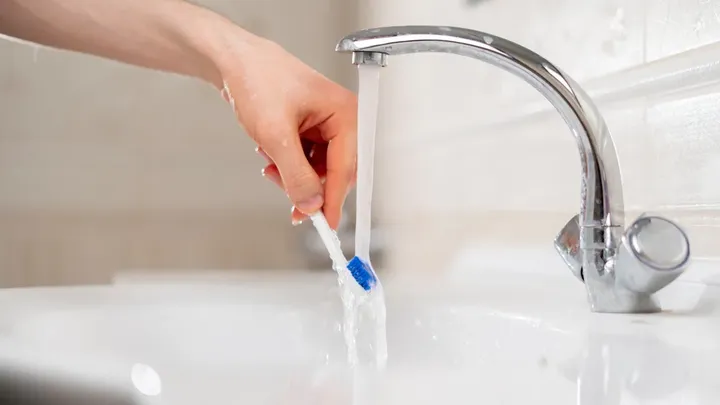
The tap goes on, the toothbrush goes under it, and then comes the toothpaste. Or perhaps you add the toothpaste first and run the brush under water afterward.
Most people have followed the same routine for years without giving it much thought. But French dentists have sparked a debate about whether wetting your toothbrush could make toothpaste less effective.
Interestingly, researchers at Vrije Universiteit Amsterdam investigated the question and reached a different conclusion.
Why some dentists recommend keeping your toothbrush dry
According to the Medident dental center in Paris, wetting your toothbrush before applying toothpaste isn't necessary and could potentially reduce its effectiveness.
The dentists explain that adding water may dilute the toothpaste, lowering the concentration of fluoride that comes into contact with your teeth. Fluoride is important because it strengthens tooth enamel and helps protect against cavities. The Paris dental center therefore recommends applying toothpaste directly to a dry toothbrush.
However, there's an important distinction: the center doesn't cite a clinical study demonstrating that briefly wetting a toothbrush causes more cavities or measurably reduces fluoride protection.
Another French dentist, Luis-Marc Favot, has offered a different explanation. He argues that water softens toothbrush bristles, potentially making them less effective at cleaning teeth.
But does scientific research support that concern?
What researchers in Amsterdam discovered
Professor Dagmar Else Slot, an expert in preventive oral care at Vrije Universiteit Amsterdam and ACTA, discussed this question with the Dutch science magazine Quest. Her research group investigated whether water influences how effectively brushing removes dental plaque.
In a 2018 study, researchers compared brushing with a dry toothbrush against using one that had been wetted beforehand. The results were remarkably similar. Dry brushing reduced plaque scores by 58%, while brushing with a wet toothbrush achieved a 57% reduction.
The difference wasn't statistically significant. The researchers also found that participants didn't notice a meaningful difference in bristle stiffness or cleaning ability.
A separate 2016 study found that rinsing the mouth with water before brushing didn't significantly improve plaque removal either.
In other words, there's little evidence that wetting your toothbrush makes it better or worse at physically removing plaque.
Wetting your toothbrush to soften the bristles? Consider this instead
For people with sensitive teeth or gums, running a toothbrush under warm water can feel more comfortable.
But British dentist Raha Sepehrara has suggested that anyone who regularly wets their toothbrush to soften the bristles might be using a brush that's too hard. That advice is particularly relevant for adults with sensitive or receding gums.
The NHS recommends soft or medium bristles for most adults. A small brush head also helps reach difficult areas without excessive pressure.
If brushing feels uncomfortable, switching to a soft-bristled toothbrush may be more useful than adding water.
It's also worth replacing your toothbrush approximately every three months, or sooner if the bristles become frayed.
What actually matters when brushing your teeth
Although experts disagree about wetting the toothbrush, they largely agree on the fundamentals of good dental hygiene.
According to official NHS guidance, adults should:
- Brush twice daily for approximately two minutes, including before bedtime.
- Use fluoride toothpaste containing at least 1,350 parts per million (ppm) fluoride.
- Clean the front, back, and chewing surfaces of every tooth.
- Use a soft or medium toothbrush and avoid brushing too aggressively.
- Spit out excess toothpaste afterward without immediately rinsing with water.
The final step helps fluoride remain in contact with your teeth for longer.
And there's another interesting finding from the Amsterdam research: brushing without toothpaste can still remove plaque. However, that doesn't mean toothpaste is unnecessary. Its fluoride and other ingredients provide important benefits beyond physically cleaning your teeth.
So, should you wet your toothbrush or not?
The reassuring answer is that you probably don't need to change your routine.
Research hasn't found a meaningful difference in plaque removal between wet and dry toothbrushes. Meanwhile, concerns about diluted fluoride from briefly wetting the brush haven't been established as a clinically significant problem.
If you prefer a dry toothbrush, that's perfectly fine. If you prefer to wet it first, there's no convincing evidence that this habit is harming your teeth.
What matters most is brushing thoroughly, using fluoride toothpaste, and choosing a toothbrush that's gentle on your gums.