
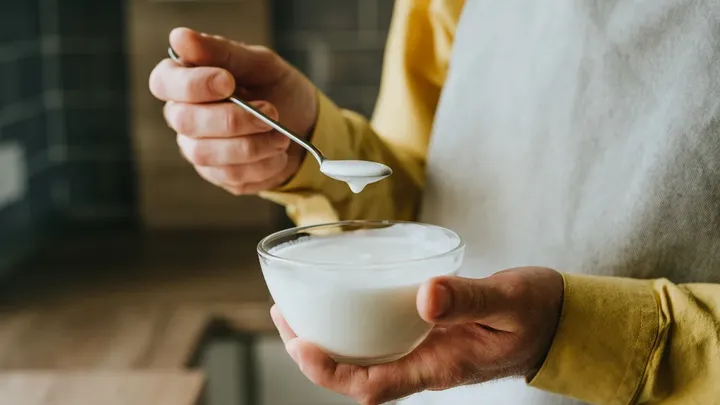
You've probably spotted them in the supermarket: little yoghurt drinks, spreads and other dairy products that promise to help lower cholesterol. They're often placed alongside everyday breakfast foods and marketed as a simple addition to a healthier routine.
If you've ever been told that your cholesterol is a little high, you may have wondered whether one of these drinks is worth trying. Some people even question whether they could be an alternative to statins, the medication commonly prescribed to lower cholesterol.
It's a question that recently caught the attention of Italian food journalists. But before adding one to your shopping basket, there are a few things worth understanding.
What do these yoghurt drinks actually do?
The key ingredients are called plant sterols and stanols. These are natural substances found in small amounts in foods such as nuts, seeds, vegetable oils and wholegrains.
They have a structure similar to cholesterol. When you consume them, they compete with cholesterol for absorption in your gut, meaning less cholesterol enters your bloodstream.
According to the Dutch Nutrition Centre (Voedingscentrum), consuming 1.5 to 3 grams of plant sterols a day can lower LDL cholesterol by around 7 to 11 per cent. LDL is often called the 'bad' cholesterol because high levels can contribute to fatty deposits building up in the arteries.
The British Heart Foundation gives a similar estimate of 7 to 12 per cent. The effect can usually be seen within two to three weeks if you take the recommended amount consistently.
Do you need to drink one at every meal?
Not at all. Plant sterols and stanols can be taken in a single serving or spread across several meals.
The British Heart Foundation explains that they work best when consumed with food. So, depending on the product, one daily yoghurt drink or serving of fortified spread may provide the recommended amount.
Check the packaging, though. The amount of plant sterols varies between products, and taking more than 3 grams a day doesn't appear to provide any additional benefit.
Can they replace statins?
This is where things become more important. Although plant sterols can lower LDL cholesterol, researchers haven't established that these products prevent heart attacks or strokes.
That's why the UK's National Institute for Health and Care Excellence (NICE) advises doctors not to recommend plant sterols and stanols specifically for preventing cardiovascular disease.
The Dutch advice is slightly different. The Health Council of the Netherlands says these products can be considered for people with cardiovascular disease caused by atherosclerosis, including those already taking statins. However, it also acknowledges that it's not known whether they actually reduce cardiovascular events.
So, while both countries recognise that plant sterols can improve cholesterol readings, that doesn't make them a proven alternative to medication.
What happened when researchers compared them with statins?
The SPORT trial, conducted at the Cleveland Clinic, compared a low-dose statin with a placebo and several dietary supplements over 28 days.
Participants taking rosuvastatin, a cholesterol-lowering medication, saw their LDL levels fall by around 38 per cent. The supplements, including a plant sterol capsule, did not lower LDL significantly more than the placebo.
There's an important distinction here: the trial tested a supplement capsule, not a fortified yoghurt drink. It shouldn't be treated as proof that the drinks don't work. However, it does show why these products shouldn't be considered interchangeable with prescribed medication.
Who should avoid plant sterol products?
These products aren't suitable for everyone. The Voedingscentrum advises against them for young children, pregnant or breastfeeding women, and people with the rare inherited condition sitosterolaemia.
They're also intended for people with raised cholesterol, rather than those whose cholesterol levels are already normal.
If you're taking medication to manage your cholesterol, speak to your doctor before adding these products to your routine. And most importantly, never stop taking a prescribed statin or replace it with a yoghurt drink without discussing it with your doctor.
Plant sterol drinks may be an option for some people looking to manage raised cholesterol. Just remember that improving a number on a blood test and protecting your heart aren't necessarily the same thing.