
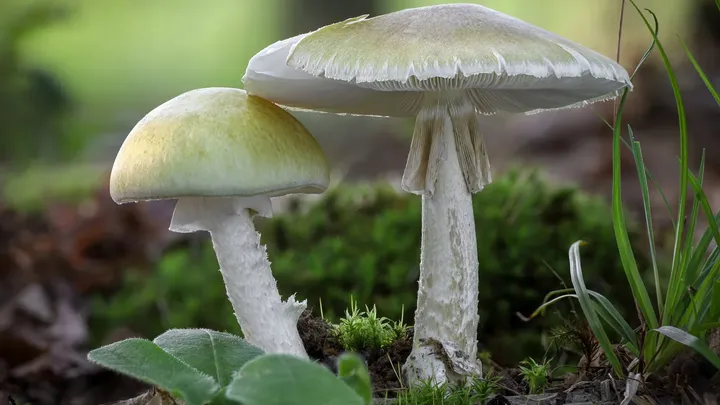
Four people in Italy were recently hospitalized after eating what they believed were edible wild mushrooms. Instead, they had accidentally consumed death cap mushrooms, one of the most poisonous species in the world.
The incident is part of a series of mushroom poisonings reported near Rome in November. But doctors are particularly concerned about one frightening feature of death cap poisoning: people can start feeling better even while serious damage is developing inside their bodies.
It's a warning worth remembering wherever wild mushrooms grow, including the United States.
Four people hospitalized after a mushroom meal
According to Italian news agency ANSA, health authorities in Frosinone, south of Rome, reported mushroom poisoning incidents involving 12 people in early November.
The most concerning incident involved four people who ate death cap mushrooms (Amanita phalloides) after apparently mistaking them for honey fungus, a mushroom commonly collected for cooking in Italy.
All four were transferred to specialist hospitals in Rome for treatment.
Death caps contain amatoxins, powerful substances that can severely damage the liver. Unlike ordinary food poisoning, the most dangerous effects may not become obvious immediately.
Why the first symptoms can be misleading
One of the biggest dangers of death cap poisoning is how slowly the symptoms can appear.
According to the Dutch National Poisons Information Center, symptoms typically begin between 6 and 24 hours after eating mushrooms containing amatoxins.
People may experience severe stomach cramps, repeated vomiting, and watery diarrhea. Because the symptoms appear hours after the meal, someone might assume they've caught a stomach virus or eaten something that simply disagreed with them.
Then comes the particularly dangerous part. After the initial illness, symptoms may temporarily improve or even disappear. Someone who spent the night vomiting might wake up feeling noticeably better.
Unfortunately, that improvement doesn't necessarily mean the poisoning has passed. The toxins may still be damaging liver cells, potentially leading to acute liver failure. In severe cases, patients may require a liver transplant.
Poison specialists are seeing concerning cases
The problem isn't limited to Italy. In October 2026, the Dutch poison center reported that 12 of 27 patients who had eaten meals prepared from personally collected wild mushrooms were strongly suspected of amatoxin poisoning. The center also reported a known death from liver failure following amatoxin poisoning, although it did not establish that the death occurred in 2026.
The United States has experienced serious cases too. According to the CDC, a California outbreak between November 2025 and March 2026 involved 39 suspected amatoxin poisoning cases, including four deaths and three liver transplants.
These incidents highlight how easily a mistake outdoors can become a medical emergency.
Cooking poisonous mushrooms doesn't make them safe
Another dangerous assumption is that thoroughly cooking wild mushrooms removes their toxins. The US Poison Control Center warns that cooking doesn't make poisonous mushrooms safe. The amatoxins found in death caps can survive normal cooking methods.
Even experienced mushroom collectors can make mistakes, particularly when edible species resemble poisonous ones. A mushroom identification app or photograph shouldn't be treated as proof that something is safe to eat. Proper identification requires specialist knowledge. This is especially important for people who learned to collect mushrooms in another country, where familiar edible varieties may resemble dangerous local species.
What to do if you've eaten a wild mushroom
If you suspect someone has eaten a potentially poisonous mushroom, don't wait for symptoms to appear.
In the United States, contact Poison Control immediately at 1-800-222-1222. The service is free and available around the clock. If someone collapses, has a seizure, struggles to breathe, or cannot be awakened, call 911.
Keep any leftover mushrooms or photographs to help specialists identify the species, but don't delay seeking medical advice.
Most importantly, don't assume that feeling better means everything is fine. When it comes to death cap poisoning, that temporary improvement can be one of the most misleading warning signs.