
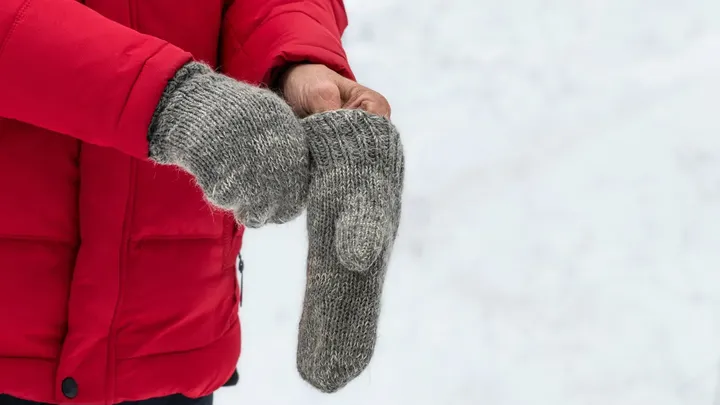
It happens every winter. You step outside, notice after five minutes that your fingers are going numb, pull on your gloves, and your hands stay cold the entire way.
Hein Daanen, emeritus professor of exercise physiology at Vrije Universiteit Amsterdam, explains in the science magazine Quest why that happens.
Gloves, like all clothing, mainly slow down how quickly heat escapes. They don't produce warmth themselves, so putting them on after your hands have become cold is much less effective.
The solution is surprisingly straightforward. And if you're choosing between gloves and mittens, there's another important difference worth knowing.
Why your hands get cold before the rest of your body
When temperatures drop, your body has one main priority: keeping vital organs such as your heart, lungs, and brain warm.
To conserve heat, blood vessels in your hands and feet narrow. This reduces the amount of warm blood reaching your fingers and toes, leaving more warmth available for your body's core.
Daanen describes this extreme reduction in circulation as circulaire amputatie, or "circular amputation." It's a vivid way of explaining how dramatically the body can restrict blood flow to its extremities.
Your hands are particularly vulnerable because they have a relatively large surface area compared with their volume. That allows heat to escape quickly, especially when you're cycling or walking into a cold wind.
Why putting gloves on too late doesn't help much
Think of gloves as insulation rather than heating. When your hands are warm, gloves help slow the escape of that warmth. But once your fingers have become cold, there's considerably less heat available to retain. That's why pulling on gloves halfway through a freezing dog walk often seems to make little difference.
Daanen recommends wearing gloves from the moment you head outside, rather than waiting until your fingers start feeling uncomfortable. Even better, put them on while you're still indoors.
In an earlier interview discussed by Meer dan Vijftig, Daanen explained that wearing your coat indoors briefly before leaving allows warmth to build up inside it.
The same principle applies to gloves: start with warm hands and keep that warmth from escaping.
Mittens or gloves: which keeps your hands warmer?
If your fingers regularly become freezing cold, switching to mittens may help. Mittens generally provide better warmth because your fingers sit together rather than being separated. This allows them to share heat instead of each finger losing warmth independently.
However, thickness matters too. A thin mitten won't necessarily be warmer than a thick, well-insulated glove. Regular gloves remain more practical when you need to handle keys, use your phone, or grip bicycle handlebars.
For cyclists, lobster mittens offer a compromise. These divide the fingers into two groups, retaining more warmth while allowing better control of brakes and gears.
Another option is layering: wearing thin insulating gloves beneath larger, wind-resistant mittens.
What if your hands are already cold?
If your fingers have already become painfully cold, simply adding thicker gloves may not be enough.
The first step is to get somewhere warmer and allow your hands to warm gradually. Avoid placing numb fingers directly against very hot surfaces, as reduced sensation can make burns harder to notice.
Keeping the rest of your body warm also matters. Research on cold-weather protection shows that maintaining warmth around the torso can help preserve comfort in the fingers and toes.
For your next winter walk, make sure your coat is warm enough, protect yourself against the wind, and put your gloves on before opening the front door.
One final warning: if your fingers repeatedly turn white, blue, or red in cold weather, particularly with pain or numbness, it could indicate Raynaud's phenomenon. Consider speaking to your doctor.
The takeaway? Don't wait until your fingers feel cold. Put your gloves or mittens on while your hands are still warm.