
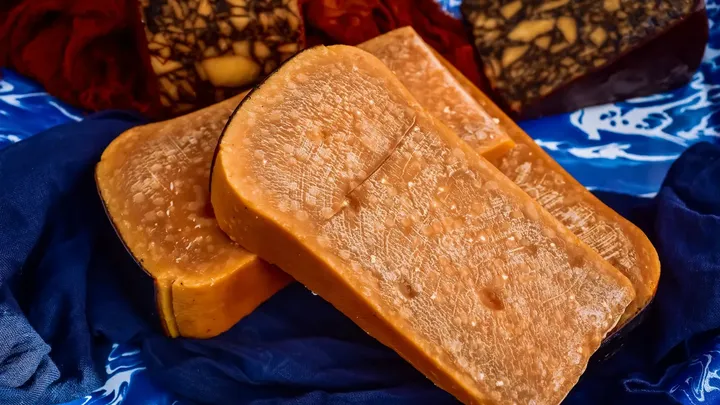
You open a fresh pack of aged Gouda and notice tiny white dots scattered across the cheese. There might even be a pale, chalky coating along the edge. It looks suspicious enough to make you wonder whether the cheese has already gone bad.
But those white spots aren't necessarily mold. The important part is knowing how to distinguish them from actual mold, because the advice changes when you're dealing with a slice rather than a whole block.
Why aged cheese develops white spots
During ripening, enzymes and microorganisms gradually change the composition of cheese. Milk proteins break down, and certain substances can form tiny crystals.
Constanze Rubach, a nutrition expert at Germany's Lower Saxony consumer advice center, explained to consumer magazine Öko-Test that this process can continue during storage and may be affected by temperature changes.
That's why the spots can appear even when you've only just opened the package. They aren't necessarily a sign that the cheese has been stored incorrectly.
You'll most commonly notice them in aged Gouda and Parmesan, although mature Cheddar and some other cheeses can develop similar markings.
Those crunchy bits are actually two different crystals
Cheese specialists distinguish between two common types of crystals.
The first is tyrosine, an amino acid released when milk proteins break down during aging. It forms small, firm crystals, often inside the cheese. These are particularly common in Parmesan and extra-aged Gouda.
The second is calcium lactate, which forms when calcium combines with lactic acid. These crystals often appear on the surface as a whitish, sometimes powdery coating. They're especially common in aged Cheddar.
Both types are natural and safe to eat. They're also responsible for some of the characteristic gritty or crunchy texture that people enjoy in mature cheeses.
How to tell cheese crystals from mold
Fortunately, there's a simple check you can make before throwing your cheese away.
According to Öko-Test, crystals generally feel firm and grainy, while mold tends to have a softer texture that can smear.
You can gently scrape the suspicious spot with a clean knife. If it remains firm and gritty, it's more likely to be a crystal. If it smears or looks fluffy, mold is more likely.
Color provides another clue. Crystals are usually white or pale yellow. Mold may be green, blue, gray, black, or even white.
Don't taste suspicious cheese to identify the spots. And remember that appearance alone cannot guarantee safety. If you're unsure whether you're looking at crystals or mold, it's safest to discard the cheese.
What if it's real mold? Here's when you can cut it away
The Dutch nutrition center Voedingscentrum makes an important exception for hard cheese.
If mold appears on a solid block of hard Gouda or Edam, you can cut away the affected area, removing at least 1 centimeter around the mold. The remaining cheese can generally still be eaten if it's otherwise in good condition.
American guidance is more cautious: the USDA recommends removing at least 1 inch (2.5 centimeters) around and below the moldy spot on hard cheese.
However, this doesn't apply to pre-sliced or shredded cheese. If actual mold appears, discard it rather than trying to save individual pieces.
Soft cheeses such as cream cheese and ricotta should also be thrown away if mold develops. Their higher moisture content allows contamination to spread more easily.
For hard cheese, proper wrapping and refrigeration help prevent spoilage. But when you notice those familiar little white crystals on your next piece of aged Gouda, there's usually no reason to panic. They may simply be part of what makes the cheese taste so good.