
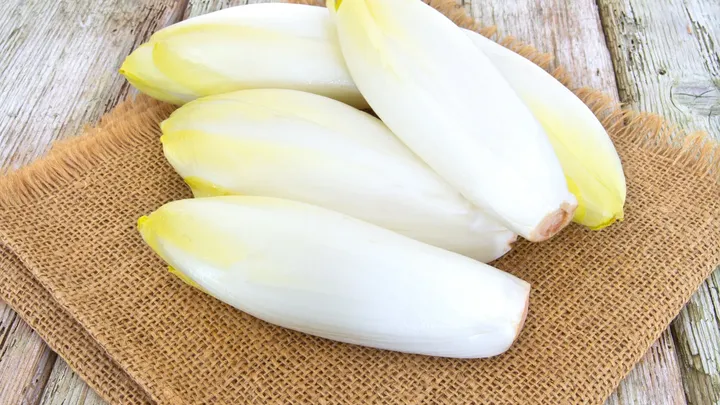
If you've ever bought Belgian endive at a market or supermarket, you may have noticed that the pale, tightly packed heads often come wrapped in dark paper. In Belgium, growers commonly use sheets of deep blue paper between the vegetables. There's a reason for this unusual packaging, and it has more to do with the vegetable itself than its appearance.
Belgian endive, also known as witloof, is a popular winter vegetable used in salads, oven dishes and stews. But it needs a little extra care once you bring it home. Here's how to store it properly and keep it fresh for longer.
Why Belgian endive needs to be kept in the dark
Belgian endive is grown from chicory roots. After harvesting, the roots are encouraged to produce new shoots in dark conditions. This gives the vegetable its characteristic white leaves and tightly packed shape.
Light changes things. When exposed to it, the leaves begin producing chlorophyll, turning them green and making their flavour more bitter. According to Libelle Lekker, this is why growers wrap the heads in blue paper.
You can recreate the same conditions at home. If your endive comes in a transparent supermarket bag, transfer it to a paper bag or wrap it loosely in paper. The aim is to block out light without trapping too much moisture. The paper doesn't have to be blue.
How long does Belgian endive last in the fridge?
The vegetable drawer is generally the best place to keep it. Store the heads in a cool, dark spot, ideally around 2–4°C, and leave them unwashed until you're ready to use them.
For most households, about a week is a sensible expectation. Libelle Lekker gives roughly a week as a guide, while Witlof.nl says storage time depends on how fresh the heads were when purchased.
Under particularly good conditions, they may last longer. Velt gives up to three weeks for unwashed heads that still have some soil attached. However, that's an ideal-condition estimate, not something to expect from every supermarket pack. Brown spots around the leaf edges are a sign that the vegetable is losing freshness.
How to make Belgian endive taste less bitter
If you prefer a milder flavour, try removing the firm core at the base of the head. Much of the bitterness is concentrated there and in the greener parts of the leaves, according to Witlof.nl.
Cooking can also make a difference. Slowly frying or braising Belgian endive allows its natural sugars to caramelise, giving it a sweeter flavour. If you're using it raw in a salad, pair it with apple, mandarin or pomegranate to balance the bitterness.
Freshly cut endive can also discolour quickly, so add a little lemon juice and prepare it shortly before serving.
Can you freeze Belgian endive?
Yes, although freezing softens the leaves, making them better suited to cooked dishes such as soup, gratin or stamppot than fresh salads.
Remove any damaged outer leaves and blanch the heads in boiling water for two to five minutes. Cool them quickly in cold water, drain and dry thoroughly before packing them into freezer bags or airtight containers. Frozen endive can keep for up to a year, according to Hoelangmoetkoken.nl.
A November project for the vegetable garden
If you grow chicory, November is a good time to lift the roots and try forcing your own Belgian endive. BBC Gardeners' World recommends trimming the leaves back and planting the roots in pots of moist compost.
Cover the pots to keep out the light and place them somewhere cool. After roughly four weeks, pale, compact heads should begin to develop. Harvest them when they're around 15 centimetres long.