
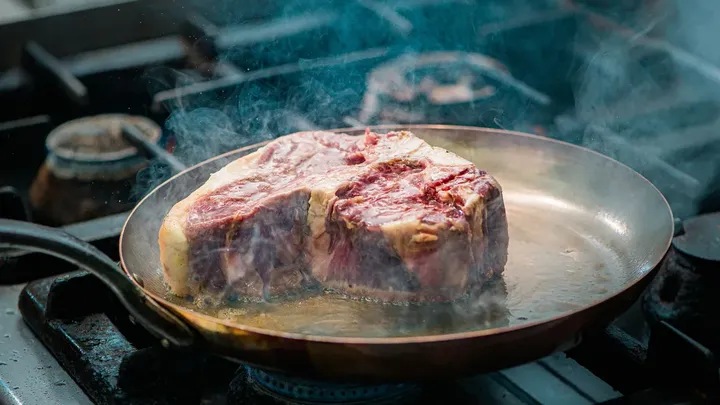
A splash of oil in the pan, wait until it's hot, then the steak goes in. Almost everyone learned it that way. But Spanish chef David Guibert, author of the cookbook Un chef en tu cocina, says this familiar habit could be making cooking unnecessarily smoky. But not every professional chef agrees with this method.
Why oil starts smoking in a hot pan
When you pour oil into an empty frying pan, it begins heating immediately. Leave it there too long, especially over high heat, and it can reach its smoke point before you've added any food.
At that temperature, the oil begins breaking down, producing smoke and potentially developing an unpleasant burnt flavor.
Guibert, speaking about a technique described in his cookbook and reported by Infobae, recommends coating the ingredients themselves. His advice is surprisingly simple: rub a little oil directly onto the meat or vegetables before placing them in a hot, dry pan. The idea is that the oil reaches the heat at the same time as the food, reducing the chance of it burning beforehand.
American cooking website Food Network offers a similar explanation. When oil covers an entire hot pan, even areas without food can smoke. Coating only the steak limits the amount of oil exposed to the hottest surface.
This doesn't eliminate smoke completely, but it may help reduce it.
The type of oil matters just as much
Even if you oil the steak rather than the pan, choosing the wrong cooking fat can still leave your kitchen smoky.
Every oil has a smoke point, although the exact temperature varies depending on its quality, refinement, and freshness.
According to Food Republic, approximate smoke points include:
- Extra virgin olive oil: 325°F (163°C)
- Regular butter: 350°F (177°C)
- Vegetable oil: 450°F (232°C)
- Refined olive oil: 465°F (241°C)
These figures are guides rather than fixed limits. Some extra virgin olive oils, for example, have considerably higher smoke points.
For very hot cooking, refined sunflower, canola (rapeseed), peanut or vegetable oil can be practical choices.
Love the flavor of butter on your steak? Add it toward the end of cooking, when you can control the heat more easily. Clarified butter is another option because its milk solids have been removed.
But one top chef prefers oil in the pan
Interestingly, Douglas Keane, chef and partner at the California restaurant Cyrus, recommends doing the opposite.
Speaking to Tasting Table, Keane explained that adding oil directly to the pan helps distribute it evenly and prevents sticking.
His concern is that steaks aren't always perfectly flat. Small crevices and uneven surfaces can make it difficult to coat every part consistently. An evenly oiled pan also gives the cook more control over how the food makes contact with the hot surface.
Neither approach is necessarily wrong. The better choice depends on what you're cooking and the pan you're using.
So when should you oil the food instead?
For one or two steaks, pork chops, or large vegetable pieces, coating the food directly is worth trying.
Pat the steak dry with paper towels, rub a thin layer of high-heat oil over both sides, and place it in a properly preheated cast-iron or stainless-steel pan.
For a winter vegetable stir-fry, toss the chopped vegetables with a little oil before cooking. This helps coat individual pieces without leaving a pool of oil in the pan.
However, when cooking irregularly shaped ingredients, delicate fish, or dishes that require frequent stirring, adding a small amount of oil to the pan may provide better coverage.
Whichever method you choose, avoid overheating the pan, keep the extractor fan running, and don't overcrowd the ingredients.
The takeaway? Next time you're cooking steak, try rubbing a little oil onto the meat instead of pouring it into the pan. You may notice less smoke, fewer splatters, and a more pleasant cooking experience.