
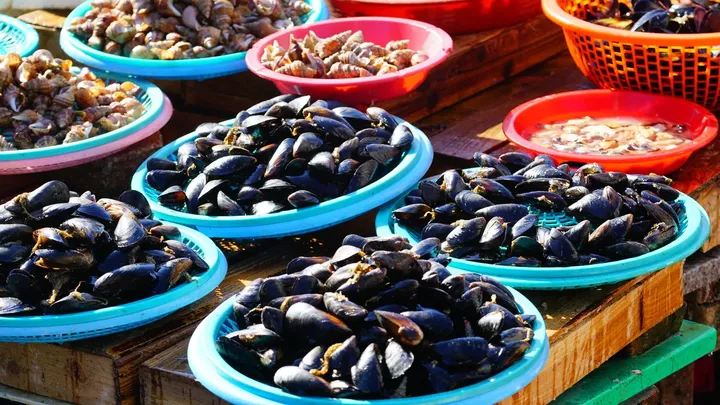
Few things are more satisfying than a big pan of freshly cooked mussels, especially when they're served with a bowl of fries and some crusty bread. So when mussels start appearing at fish counters, it's tempting to bring some home straight away. But according to one Spanish fishmonger, there's a good reason not to rush.
His advice about buying mussels recently caught people's attention, challenging what many shoppers assume about the best time to enjoy them. It's a simple recommendation, but one that could change when you plan your next mussel dinner. So, is there really a better time to buy them, and what should you look for when choosing a batch?
Why the time of year makes a difference
Spanish fishmonger Javier Martín recently advised shoppers to buy mussels in winter rather than wait until spring. As reported by EL ESPAÑOL, the reason comes down to their reproductive cycle.
During spring and early summer, mussels use much of their energy to reproduce. Afterwards, they feed on plankton and gradually rebuild their reserves, leaving more meat inside the shell. The exact timing varies depending on the species and where the mussels are grown.
Why the Dutch often wait until autumn
The same pattern is familiar in the Netherlands, particularly in Zeeland, where mussels are an important part of the local food culture.
Mussel chef Pim van Engelenburg explained to Horeca Magazine that mussels are traditionally fuller in autumn and winter. Some people in Zeeland deliberately wait before buying their first mussels of the season.
According to MAX Vandaag, fresh Zeeland mussels are generally available from July until around April, with September to November considered particularly good months.
The 2026 season started early
This year's Zeeland season got off to an unusually early start. The first rope-grown mussels were harvested around mid-May. These mussels grow suspended from ropes rather than on the seabed and account for roughly 5% of Dutch production, according to Levensmiddelenkrant.
The first bottom-culture mussels followed on 18 June, earlier than usual. After two difficult years, growers were hopeful about a better harvest, reporting healthy stocks and promising meat percentages, according to Horeca Magazine.
Does the old rule about months with an R still apply?
The traditional advice was to eat mussels only in months containing the letter R. This made sense when refrigeration and transporting fresh seafood were less reliable.
Today, modern cultivation and refrigerated transport mean mussels are available outside those months. The old rule is no longer necessary, although its timing does overlap with much of the period when Zeeland mussels are traditionally at their fullest.
What to check before cooking
Buying mussels at the right time of year is only part of the story. Before putting them in the pan, remember these simple checks:
- Check the shells: Discard any that are broken or badly damaged.
- Try the tap test: If a raw mussel is open, tap it gently. If it doesn't close, discard it.
- Rinse in cold water: Clean the mussels and remove any beards if necessary.
- Cook thoroughly: The Allerhande Zeeland-style recipe recommends cooking them with the lid on for around 5 to 8 minutes, shaking the pan regularly.
- Check after cooking: Follow the Voedingscentrum's food-safety advice and discard mussels that remain closed.
MAX Vandaag also notes that a 2-kilo box can contain around six bad shells, although this is an estimate rather than a fixed rule.
So, if you're planning a mussel dinner, don't assume the first ones to arrive at the fish counter are necessarily the best. Depending on their origin, waiting a little longer could make a noticeable difference.