
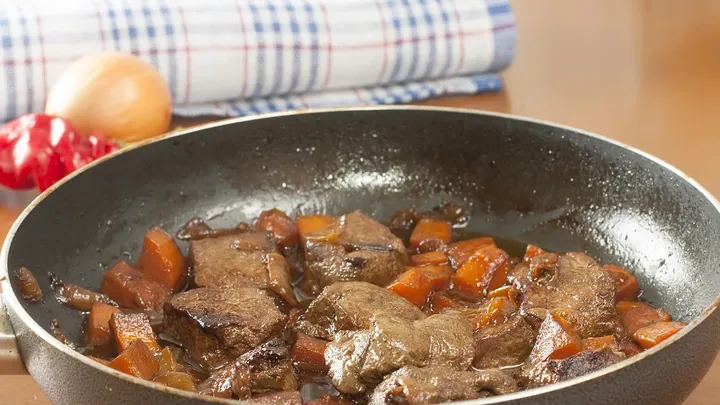
You heat the pan, add the cubes of stewing beef or the ground beef, and within a minute, everything is bubbling in a pool of grey liquid. Instead of developing a rich brown crust, the meat seems to be boiling in its own juices.
Spanish butcher Mariano Sánchez recently attracted attention with a warning about this common cooking mistake. And with stew season underway, understanding this small detail can make a noticeable difference to your next dinner.
Why meat releases water instead of browning
Meat naturally contains plenty of water. As it heats, its proteins change shape and release some of that moisture. This is completely normal. The problem begins when the liquid cannot evaporate quickly enough.
For meat to develop a brown crust, its surface generally needs to reach temperatures around 140–150°C (284–302°F) or higher. This triggers the Maillard reaction, the chemical process responsible for much of the delicious flavor and aroma of browned meat.
But as one meat supplier explains, when liquid accumulates, much of the pan's energy goes into heating and evaporating it. Water boils at approximately 100°C (212°F). As long as the meat's surface remains wet, it struggles to reach the higher temperatures needed for strong browning.
That's why meat can be fully cooking on the inside while remaining pale and grey on the outside.
The mistake most people make with the pan
One of the biggest problems is adding too much meat at once.
Imagine tipping a large package of ground beef into a small frying pan. The cold meat immediately lowers the pan's temperature, while dozens of pieces begin releasing moisture simultaneously. With nowhere for that moisture to evaporate quickly, it collects at the bottom.
Overcrowding effectively turns frying into steaming or simmering. Instead of browning against the hot metal, the meat cooks in its own liquid.
The solution is straightforward: cook smaller portions and leave some visible space between the pieces. For ground beef, allowing larger sections to brown before breaking them into smaller crumbles can also help develop more flavor.
A sheet of paper towel can help
Another useful trick happens before the meat even touches the pan.
Experts recommend patting meat dry with paper towels while the pan heats. Removing moisture from the outside allows the meat to make better contact with the hot surface.
This is particularly helpful with meat that has been thawed or has collected liquid inside its packaging.
Salt also deserves some attention. Salting immediately before cooking avoids leaving the meat sitting with newly drawn-out moisture on its surface.
Alternatively, you can salt larger cuts well in advance, refrigerate them, and pat the surface dry before cooking. Both approaches can work.
Does watery meat mean poor quality?
Not necessarily.
Even good-quality meat releases moisture during cooking. Previously frozen meat may lose more liquid after thawing because ice crystals can affect its structure.
A wet surface, an insufficiently heated pan, or overcrowding can make the liquid much more noticeable.
So a puddle in the frying pan isn't automatically evidence that the meat contains added water.
How to get better browning tonight
Before preparing your next beef stew, heat a heavy-bottomed pan over medium-high heat and add a thin layer of suitable cooking oil.
Pat the meat dry, add a few pieces at a time, and let them develop color before turning. Transfer each browned batch to a plate while you cook the rest.
If liquid has already collected, remove the meat briefly and let the excess moisture evaporate before continuing. Avoid cooking quick-cooking cuts for too long just to achieve a crust.
Once everything is browned, add broth or another cooking liquid to loosen the flavorful brown bits from the bottom of the pan, then continue with your stew.
It takes a little more patience, but giving the meat enough room to brown is often the difference between a watery pan and a richly flavored dinner.