
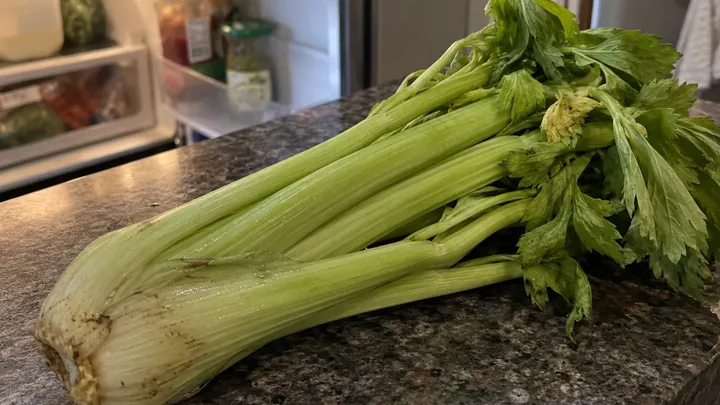
Celery rarely makes it to the end of the bunch. A few stalks go into the soup, and a week later the rest bends like rubber at the back of the vegetable drawer.
Online, a viral fix tells us: take it out of the plastic and wrap it in aluminum foil. People who try it say the stalks really do stay crisp for longer. But let's go deeper into the subject to understand it.
What scientists say about the gas that supposedly makes celery go limp
Ethylene is a natural gas released by fruits and vegetables as they ripen and age. It's the reason storing certain produce together can sometimes make it spoil faster.
But celery is a little different. According to the UC Davis Postharvest Research and Extension Center, celery produces less than 0.1 microliters of ethylene per kilogram per hour at 68°F (20°C). That's a very small amount.
Researchers also found that celery isn't particularly sensitive to low levels of ethylene when kept cold. Higher concentrations can cause it to lose its green color, especially at warmer temperatures.
That doesn't mean ethylene is completely harmless. The University of Florida's agricultural researchers still recommend keeping celery away from fruits that release larger amounts of the gas, such as ripening avocados.
However, the idea that celery quickly goes limp because its own ethylene gets trapped inside plastic doesn't fit the research very well.
The real reason celery loses its crunch
Celery contains a lot of water, and that water is what helps its stalks stay firm and crisp.
Once celery is harvested, it continues losing moisture but can no longer replace it through its roots. As the water disappears, the stalks gradually lose their firmness.
Penn State Extension explains that many types of fresh produce begin to wilt and shrivel after losing roughly 5 to 10 percent of their original weight.
This is where aluminum foil comes in.
Wrapping celery helps protect it from the dry air inside your refrigerator, slowing down moisture loss. Foil can therefore help preserve its crunch, even if the popular explanation about escaping ethylene is misleading.
And contrary to what some online videos suggest, plastic isn't necessarily bad for celery. Packaging that retains moisture can also help prevent wilting. The important thing is to keep the stalks cold and protected from drying out, without allowing excessive moisture to collect around them.
The best way to wrap celery in aluminum foil
If you want to try the foil trick, start with a fresh, firm bunch of celery.
Keep the stalks together rather than cutting the entire bunch into pieces. Remove any damaged or decaying parts, then wrap the celery in a sheet of aluminum foil.
The foil should fit snugly around the stalks without crushing them. There's no need to seal every edge airtight.
Place the wrapped bunch in your refrigerator's crisper drawer, where it's protected from drying air and temperature changes.
Keeping celery cold matters just as much as wrapping it. UC Davis researchers report that celery can maintain good quality for five to seven weeks under carefully controlled commercial storage conditions, close to 32°F (0°C) and with very high humidity.
Every home refrigerator is different, so that figure shouldn't be treated as a promise. There is also no reliable evidence establishing exactly how many extra days foil provides in an ordinary home refrigerator.
What food experts recommend instead
Aluminum foil isn't the only way to keep celery fresh.
The Dutch Nutrition Centre recommends keeping leftover raw celery refrigerated in reusable plastic wrap or a sealed food container. Its official storage guidance gives opened celery a refrigerator storage period of approximately one week.
Produce organization Verse Oogst also recommends keeping celery in the vegetable drawer for about a week.
If you won't use the remaining stalks in time, freezing is another option. Cut them into pieces, blanch them briefly in boiling water, cool them quickly, and freeze them in a suitable container.
Frozen celery is particularly useful for soups, stews and sauces, where its original crunch matters less.
Can you make limp celery crisp again?
If your celery has already started to bend, it doesn't necessarily belong in the trash.
Sometimes the stalks have simply lost moisture, rather than spoiled.
Cooking website De Kookclub suggests standing the base of the stalks in about an inch (2–3 cm) of water and replacing that water daily.
You can also try placing limp stalks in cold water in the refrigerator for a few hours. They may absorb some moisture and regain part of their firmness, although badly deteriorated celery won't return to its original condition.
If the celery is slimy, moldy, or smells sour, however, discard it rather than trying to revive it.
So the next time you buy celery for a pot of soup, don't leave the unused stalks sitting uncovered in the refrigerator. Aluminum foil is worth trying, but it's the protection against moisture loss, rather than a special ability to release gas, that offers the more convincing explanation.