
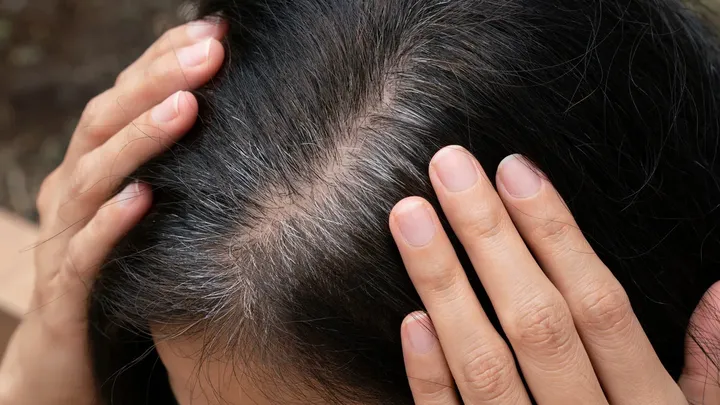
Every four to six weeks, it's the same routine: another salon appointment or another box of hair dye. But if you're tired of covering your grey roots, you might be thinking about letting your natural colour grow out. The hardest part is often the visible line between silver roots and darker, dyed lengths.
It can be tempting to apply one last dark colour before stopping, hoping to make everything look neater. But that can leave you with an even stronger contrast as your grey grows in. The good news is that there are ways to soften the line without bleaching your entire head or cutting off all your hair.
Why the roots are so noticeable
Hair grows by roughly a centimetre a month on average, so your natural grey gradually becomes more visible. If you've been colouring your hair dark brown or black, the difference can be particularly striking.
The Watermans guide to transitioning to grey estimates that the process can take around nine to eighteen months, depending on your starting colour, hair length and how much grey you have.
Another dark dye won't stop grey roots from appearing. Instead, it adds more coloured length that you'll eventually need to grow out. Repeatedly colouring the same sections can also make a later salon transition more complicated.
How colourists soften the transition
You don't have to put up with a sharp line between your roots and lengths for months on end. A colourist can use several techniques to help the shades blend more naturally.
- Babylights: These very fine highlights break up blocks of colour and soften the contrast between grey roots and dyed lengths.
- Lowlights: Adding darker strands can restore depth if your hair looks too light or flat, creating a more natural mix of shades.
- Root smudge: A colourist blends a softer shade around the roots, making the boundary between new growth and coloured hair less obvious.
- Balayage: This technique creates gradual highlights rather than a strong line, particularly on longer hair.
The right option depends on your existing colour, the amount of grey and your hair's condition. If your hair is very dark, ask about a gradual transition rather than trying to match the roots to your old dyed shade. The Hair Culture guide explains how colourists can combine highlights, lowlights and toning to create a softer result.
Why bleaching everything at once can backfire
You might think that lightening all your hair in one go is the quickest way to get rid of the contrast. However, previously coloured hair can be difficult to lighten evenly, especially after years of dark dye. Trying to remove too much colour in one session can leave hair dry, brittle or prone to breakage.
A colourist may recommend several appointments instead, gradually blending the old colour with your natural grey. This takes longer, but it gives them more control over the result and the condition of your hair.
Could a shorter haircut help?
If you're happy to lose some length, a haircut is one of the simplest ways to speed up the transition. The more dyed hair you remove, the less you have left to grow out.
You don't have to go straight to a pixie cut. A bob or regular trims can gradually remove the coloured ends while allowing your natural grey to take over.
How long will it take?
There's no single timeline. A shorter cut can remove much of the old colour quickly, while long hair that has been dyed dark for years may take considerably longer. Highlights and root blending can make the wait easier, although they usually involve extra salon visits and costs.
The important thing is to choose an approach that suits your hair and your budget. Grey hair doesn't need to be perfectly uniform to look good, and the transition doesn't have to happen overnight. Rather than reaching for one last box of dark dye, consider asking a colourist how to make your natural silver, white and darker strands work together as they grow.