
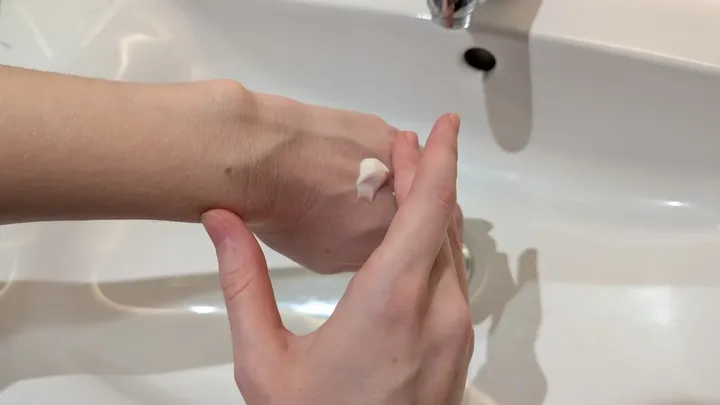
The first cold weeks often show up badly on your hands. Your knuckles feel rough, your skin feels tight after washing, and small cracks start appearing around your fingertips. You might already have a pump bottle of hand lotion sitting by the sink, but dermatologists say a different kind of cream might work better.
Why dermatologists prefer a tube over a pump
That convenient bottle of lotion on your bathroom counter isn't necessarily bad for your hands. But its contents may not be rich enough when winter dryness becomes a problem.
In its hand-washing advice, the American Academy of Dermatology specifically recommends creams and ointments squeezed from a tube rather than thinner products pumped from a bottle.
These thicker products help the skin retain moisture more effectively. The Academy also recommends choosing fragrance-free and dye-free formulas, since added fragrances and coloring can irritate sensitive skin. The important distinction is the formula, not the packaging itself.
According to AAD dermatologist Shani Francis, thick creams and ointments are particularly useful for very dry skin. Ordinary butters and oils may be less effective because they tend to liquefy on the skin.
The best time to apply hand cream is right after washing
You don't have to wait until your hands feel rough to reach for moisturizer. Dermatologists recommend applying it every time you wash your hands, while the skin is still slightly damp. This helps trap moisture before it evaporates.
Gently pat your hands dry, then rub in a pea-sized amount of moisturizer. Pay particular attention to your fingertips and the skin around your nails, where painful cracks often develop.
Water temperature matters, too. According to Harvard Health, warm water is less drying than hot water, so turning down the temperature can help.
One practical way to build the habit is to keep a tube of hand cream beside every sink. That way, you can moisturize immediately after washing instead of remembering hours later.
The simple overnight treatment for cracked hands
If your hands are already painfully dry, applying cream during the day may not be enough.
Harvard Health recommends an additional nighttime routine: cover your hands with a thick moisturizer or plain petroleum jelly before going to bed.
Then slip on a pair of soft cloth gloves. Don't have any? A clean pair of cotton socks can serve the same purpose. The gloves help keep the moisturizer in place overnight, giving it more time to protect your skin while you sleep.
Petroleum jelly is particularly useful because it forms a protective barrier that reduces moisture loss. It doesn't add water to the skin by itself, so applying it after moisturizing can be helpful.
Choose a plain, fragrance-free product, especially if your skin is sensitive. If you have eczema or a known skin allergy, avoid products that have previously caused irritation.
Don't forget to protect your hands during the day
Cold weather isn't the only thing drying out your hands. Washing dishes, cleaning bathrooms, gardening, and frequently using soap can all contribute.
The American Academy of Dermatology recommends wearing protective gloves when your hands are exposed to water and using warm gloves outdoors in cold, dry weather.
If your home's heating makes the indoor air particularly dry, a humidifier may also help. Just remember to clean it regularly.
You should still wash your hands when needed. The goal isn't to avoid good hygiene, but to replace moisture afterward and reduce unnecessary irritation.
When dry hands need more than moisturizer
Occasional roughness is common in winter, but persistent cracking shouldn't automatically be dismissed as dry skin.
Hands that become intensely itchy, inflamed, thickened, or scaly may have hand eczema, a condition that sometimes requires prescription treatment.
See a dermatologist if dry skin doesn't improve with appropriate care. Seek medical advice sooner if cracks are deep, painful, or repeatedly bleeding. Spreading redness, warmth, swelling, pus, or yellow crusts can indicate an infection and need prompt assessment.
For most people, though, the first change is straightforward: choose a richer moisturizer, keep it within reach, and use it while your hands are still slightly damp.
That ordinary tube beside the sink may turn out to be more useful than another bottle of lotion sitting in the bathroom cabinet.