
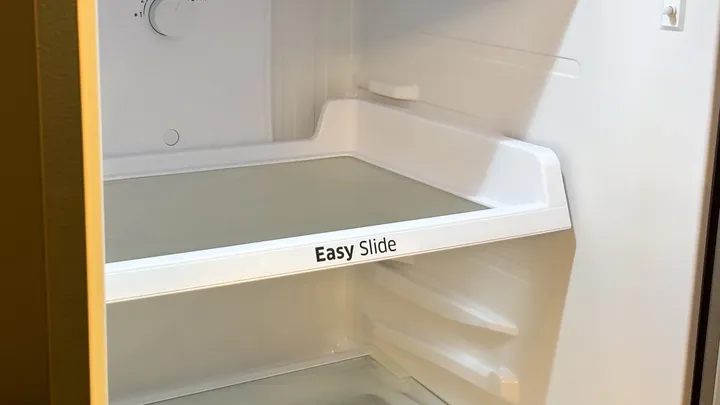
Most people set their fridge once, often a notch colder 'to be safe', and never touch it again. But the numbers on that little dial don't mean what many people think.
On many refrigerators, a higher number means more cooling, not a particular temperature, and turning it up unnecessarily could be adding to your electricity bill.
Fortunately, there's an inexpensive way to check whether your fridge is running at the right temperature. All you need is a thermometer and a glass of water.
What the numbers on your fridge dial actually mean
If your refrigerator has a dial numbered from 1 to 5 or 1 to 7, those numbers generally represent cooling settings rather than degrees Celsius.
On many models, turning the dial to a higher number makes the refrigerator colder. But setting 3 on one appliance might produce a different temperature from setting 3 on another.
The Dutch nutrition authority Voedingscentrum explains that room temperature, how full the refrigerator is, and how frequently the door opens can all affect its internal temperature. Even digital displays don't always reflect the actual temperature inside.
That's why checking with a separate thermometer is more reliable than trusting the dial alone.
What temperature should your fridge actually be?
Food safety authorities have slightly different recommendations depending on the country.
- Netherlands: Voedingscentrum recommends 4°C (39°F).
- Belgium: The food safety agency FAVV recommends between 0°C and 4°C in the coldest section.
- United Kingdom: The Food Standards Agency recommends 5°C (41°F) or below.
- United States: The FDA recommends 40°F (4°C) or below.
The difference between British and Dutch advice is relatively small. For households following Dutch, Belgian or American guidance, 4°C is a sensible target.
The UK Food Standards Agency has also found that fewer than one-third of households had a thermometer in their refrigerator.
Its research suggests that some people confuse the dial setting with the actual temperature.
How much electricity does an overly cold fridge waste?
Keeping your refrigerator unnecessarily cold costs electricity, although the savings from adjusting it are usually modest.
According to Selectra Belgium, each degree of unnecessary cooling increases refrigerator electricity consumption by approximately 5%. Its estimate for freezers is between 5% and 10% per degree.
For a fridge-freezer consuming 250 kWh annually, Selectra calculates that operating at 3°C instead of 4°C could cost roughly €4 ($4.4) extra per year under its assumed Belgian electricity price.
At 2°C, the estimated additional cost rises to approximately €9 ($9.88) annually.
These are illustrative estimates rather than guaranteed savings. Actual consumption depends on the appliance, its age, the surrounding temperature and electricity prices.
Excessive cooling can also damage food. Lettuce, cucumbers and other delicate products may partially freeze, particularly near the back wall.
The simple glass-of-water test
You can check your refrigerator's actual temperature without calling a technician.
Here's how:
- Fill a glass with water and place a suitable thermometer inside.
- Put the glass on a lower shelf, preferably near the middle.
- Keep the refrigerator closed as much as possible and leave the glass overnight.
- Check the temperature before deciding whether to adjust the dial.
The water helps smooth out temporary temperature changes caused by opening the door.
Although you may take an initial reading after a few hours, leaving the thermometer overnight gives a more reliable result.
If the thermometer shows more than 4°C, your fridge is too warm, so turn the dial up slightly to make it colder. If the temperature is well below 4°C, you can turn the dial down slightly to make it warmer and save electricity.
Wait until the following day before checking again. Avoid making several adjustments at once.
Don't forget the freezer
Temperature also varies between refrigerator shelves.
Raw meat and fish belong on the colder lower shelves, in sealed containers that prevent leaks. Drinks, butter, and sauces generally tolerate the warmer door compartments.
For the freezer, aim for -18°C (0°F).
To measure freezer temperature, place a suitable thermometer between frozen packages and allow it to stabilize. Don't use a glass of water, which could freeze and break the glass.
The next time you open your fridge, take a closer look at that dial. A thermometer can tell you whether your food is being stored safely without paying for unnecessary cooling.