
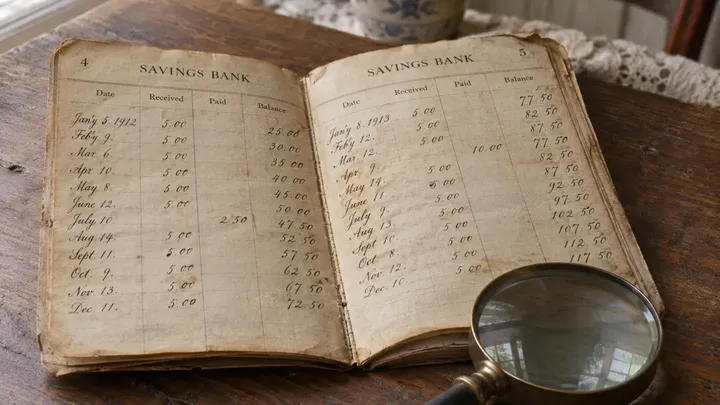
An Italian pensioner clearing out old family belongings made an extraordinary discovery. Hidden between the pages of an old book was a savings booklet belonging to her grandmother, dated February 22, 1915.
More than a century later, a financial consultant has estimated that the forgotten savings could be worth approximately €108,000.
But there's an important catch: the money hasn't been paid out, and whether the family can legally claim it remains uncertain.
The discovery raises an interesting question for anyone who has inherited old belongings: could a forgotten savings account still contain money?
The surprising discovery inside an old book
According to Italian newspaper Quotidiano Piemontese, the woman, identified as Piera F., was born in 1953 and lives in Carpignano Sesia, northern Italy. She discovered the old postal savings booklet inside a book stored in a family chest. It had belonged to her grandmother, who died during the 1940s.
Piera contacted the consumer organization Associazione Italia, which arranged for a consultant to examine the document. After calculating potential interest, monetary revaluation, and capitalization, the consultant estimated a claim of approximately €108,000.
However, this is an estimate, not a confirmed account balance. Italian rules concerning dormant accounts and legal time limits could prevent payment. The case has reportedly entered legal proceedings.
Why old savings accounts aren't necessarily worthless
Decades ago, many people opened savings accounts using paper booklets. Every deposit or withdrawal was recorded inside, often with a bank stamp.
Some accounts were forgotten when families moved, relatives died, or banks merged.
Finding an old booklet doesn't automatically mean money is waiting. The account might have been closed, transferred, or emptied without the booklet being updated.
However, some forgotten balances remain recoverable, even after many years.
Fortunately, several countries provide free services to help people investigate.
Britain has a free service for finding forgotten accounts
If you live in the United Kingdom, start with My Lost Account.
This free service searches for forgotten bank accounts, building society accounts and National Savings and Investments products.
More than 70 financial providers participate, meaning you don't have to contact every institution individually.
You can also search for accounts belonging to deceased relatives, provided you have the necessary authority and documentation.
The service helps locate accounts; it doesn't guarantee that money will be found.
How to find forgotten bank accounts in the Netherlands
In the Netherlands, the first step is contacting the bank named in the savings booklet.
If you're handling a deceased relative's estate and don't know which bank held their money, the Dutch Banking Association operates a free service called Loket Slapende Tegoeden.
Participating banks search their records, and applicants generally receive an answer within three months.
Interestingly, Dutch banks say they will still pay valid dormant balances after 20 years if ownership and the outstanding balance can be established, even though a legal limitation period may apply.
Belgium and America also have ways to recover forgotten money
In Belgium, forgotten bank balances may be transferred to the government's Deposito- en Consignatiekas.
People can check for dormant funds through MyMinfin and, where eligible, request repayment electronically.
In the United States, abandoned accounts are generally handled through state unclaimed-property programs.
The National Association of Unclaimed Property Administrators recommends MissingMoney.com, a free search service covering participating states.
Checking every state where you've lived is worthwhile.
Found an old savings book? Don't throw it away
Before contacting a bank, photograph the booklet and note the account number, owner's name, last recorded balance, and any former addresses.
Keep the original document somewhere safe. Don't mail it unless the bank specifically requests it through a verified process.
If the account belonged to a deceased relative, you may need proof of death and documents establishing your right to claim the money.
Most discoveries won't produce anything approaching €108,000. Some accounts may contain only a few dollars or euros, while others may no longer have a balance.
Still, that dusty savings booklet in an old drawer could be worth checking before you throw it away.