
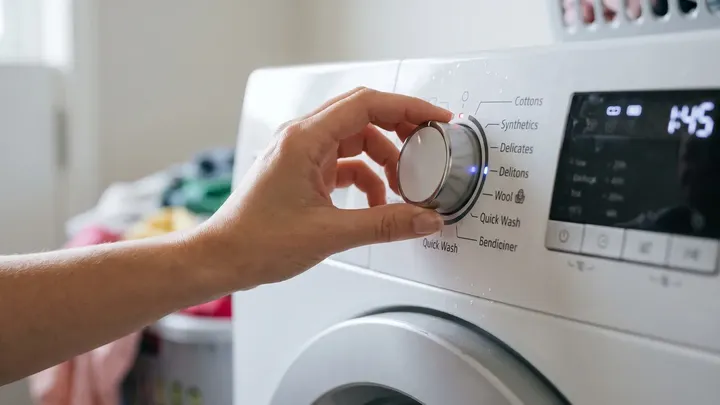
Most of us wash our clothes at 30 or 40 degrees these days to save energy. But when it comes to kitchen towels, dishcloths and hand towels, a higher temperature is often recommended to remove bacteria. Interestingly, setting your washing machine to 60°C (140°F) doesn't necessarily mean that's the temperature your laundry will reach.
Researchers at De Montfort University in Leicester, England, tested six models of household washing machines and discovered considerable differences in their ability to remove bacteria. Their findings suggest that your choice of wash cycle deserves just as much attention as the temperature setting.
Why kitchen towels need a hotter wash
Think about how often you use the same kitchen towel throughout the day. You might dry your hands, wipe the kitchen counter, or clean up spilled food. Between uses, the damp fabric provides favorable conditions for bacteria to multiply.
The Netherlands Nutrition Centre (Voedingscentrum) recommends replacing dishcloths daily and washing them at 60°C. Its food hygiene guidance also recommends washing kitchen towels and hand towels at this temperature.
Although washing at lower temperatures can remove visible dirt and reduce bacteria, a towel that looks and smells clean isn't necessarily free from potentially harmful microorganisms.
Only three of the six washing machines passed the test
In a study published in PLOS ONE on April 30, 2025, researchers led by microbiology professor Katie Laird investigated whether household washing machines could adequately disinfect fabrics used in healthcare uniforms.
Only three of the six machines consistently achieved sufficient bacterial reduction across both detergents tested during a full-length 60-degree cycle.
Five machines reached peak temperatures of approximately 57 to 58 degrees. One machine, despite being set to 60 degrees, reached an average maximum temperature of just 20.5 degrees.
The rapid wash cycles also produced inconsistent results. Three machines failed to get sufficiently hot and did not achieve the required level of bacterial reduction.
While the study focused on healthcare uniforms rather than household towels, it highlights an important difference between selecting a temperature and actually achieving it.
Think twice before pressing the quick-wash button
A quick wash is convenient when you're short on time. However, when hygiene is particularly important, it's worth choosing a full-length wash cycle instead.
Eco settings deserve some attention, too. An Eco 40–60 cycle is designed to clean normally soiled cotton laundry efficiently, but the water temperature may be lower than the numbers suggest.
For kitchen towels and dishcloths, consider the following:
- Choose a full-length cotton cycle at 60°C if the care label permits.
- Avoid shortening the cycle using the quick-wash function.
- Use the recommended amount of laundry detergent.
- Avoid overloading the washing machine.
- Dry everything thoroughly after washing.
Check your washing machine's manual for information about its hygiene or sanitizing cycles.
Your washing machine itself could harbor bacteria
The Leicester researchers also discovered bacterial communities, known as biofilms, inside washing machines. These can develop in areas such as the detergent dispenser and the rubber door seal.
Fortunately, keeping these areas clean doesn't require much effort. Regularly remove and clean the detergent drawer, wipe underneath the folds of the rubber seal, and remove any accumulated moisture or residue.
Many manufacturers also recommend running an empty machine-cleaning cycle approximately once a month. Follow the instructions for your particular appliance.
Not everything needs to be washed at 60 degrees
There's no need to abandon cooler washes altogether. Lightly worn shirts, trousers and other everyday clothing can generally be washed at lower temperatures, saving energy and helping protect the fabric.
For kitchen textiles, however, a hotter wash is worth considering. Extra attention to laundry hygiene is also sensible when someone in your household is ill. Always follow the fabric's care instructions and any illness-specific hygiene advice.
The next time you put a pile of kitchen towels in the washing machine, check more than just the temperature on the display. Giving the machine enough time to do its job may make an important difference.