
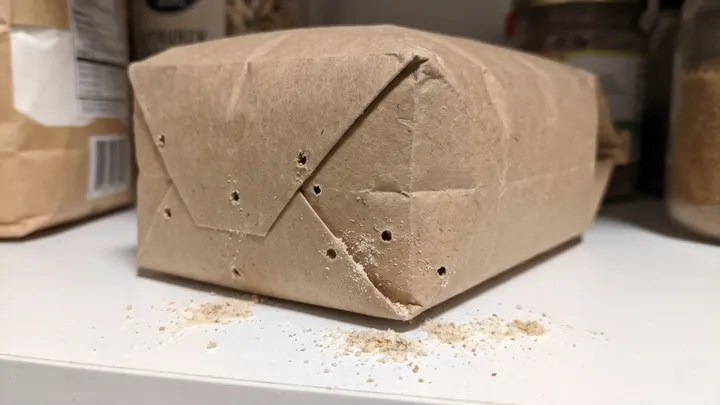
First, you notice a few tiny holes in a packet of crackers. Then there's a fine dust at the bottom of a spice jar, and some of your stored food doesn't look quite right. You throw away the flour, wipe down the shelves and think the problem is solved. But a few weeks later, the same damage appears again.
It's frustrating when a thorough clean doesn't seem to make a difference. The problem may not be with your cleaning routine at all. Sometimes, the source is much harder to find than the damaged packets suggest, and it can take a little detective work to track it down.
How to recognise a drugstore beetle
The culprit could be the drugstore beetle (Stegobium paniceum), also known as the biscuit beetle in the UK. According to Dutch pest knowledge centre KAD, it is just 2–4 mm long, with an oval, finely haired body that ranges from brown to reddish brown. Its larvae are white, have a dark head and can grow to around 5 mm.
You may notice the adult beetles crawling on windowsills or flying towards lights. Another clue is a collection of tiny, round holes in food packaging. The KAD explains that the beetles can bore through paper, plastic and thin metal foil.
The drugstore beetle can also be confused with the cigarette beetle. The two look remarkably similar, so if you're unsure, it's worth asking a pest expert to identify a specimen.
The source may be nowhere near your kitchen
The larvae are responsible for most of the feeding damage. They can develop in dry, starchy products such as bread, crackers, pasta, stock cubes and pet food. Flour, dried fruit, nuts, spices and seeds can also provide a food source.
But here's where things get interesting. Virginia Tech's entomology experts point out that drugstore beetles can be found near birdseed or dry pet food stored in garages. They may also develop in old mouse nests inside wall cavities or attics, especially when rodents have stored seeds or other food there.
Texas A&M researchers also identify forgotten pet food, spilled birdseed and abandoned rodent nests as possible sources.
So if you've cleaned the kitchen several times and the problem keeps returning, it's time to widen your search.
Check the oldest packets first
Start with the food that's been sitting in your cupboards the longest. Michigan State University recommends checking older and opened packets of flour, dried fruit, nuts and spices, as well as dog food and birdseed.
Don't just look for live insects. Check for tiny holes, fine powder, larvae and damaged contents. Inspect seemingly untouched packets too, as the insects can get through surprisingly small openings.
Throw away heavily infested food in a tightly sealed bag and take it straight to the outdoor bin. Then empty the cupboards and vacuum the corners, seams and cracks. Pay attention to screw holes and shelf supports, where insects may be hiding. KAD recommends thoroughly cleaning the storage area after removing the source.
Once everything is clean, transfer dry foods into airtight glass or metal containers to make it harder for pests to reach them.
Can you save doubtful food in the freezer?
If a product is only suspected of being infested, heat or cold treatment may kill the insects. Oklahoma State University recommends spreading suitable dry products in shallow trays and heating them at 130–150°F (around 55–65°C) for 30 minutes. Alternatively, it suggests freezing them at 0°F (around -18°C) for seven to ten days.
For small quantities of pet food, Texas A&M recommends freezing for two weeks. However, heavily infested food is better discarded rather than salvaged.
What if they're living in the kitchen itself?
Sometimes, the problem goes beyond food. KAD warns that the larvae can develop in certain building materials containing plant fibres or seed residues, including some types of particleboard used in kitchen cupboards.
Dutch consumer programme Radar reports that when the beetles have established themselves inside this material, replacing the affected boards may be the only lasting solution.
Pheromone traps can help monitor whether the beetles are still present, but they won't remove the source. Chemical sprays are rarely the answer when larvae are hidden inside food or cupboard materials, and shouldn't be used around exposed food.
The important thing is not to panic if you still spot an occasional beetle after cleaning. Michigan State University notes that the life cycle can take around two months under suitable conditions, so adults may continue to emerge for a while. The real priority is finding and removing the place where they're breeding.