
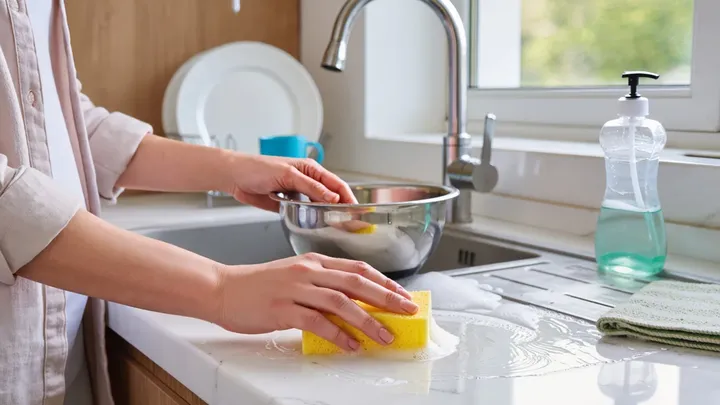
The kitchen sponge is one of those everyday items we rarely think twice about. We use it to wash dishes, wipe away food scraps and clean up spills. A quick rinse under the tap, and it seems ready to go again.
But sponges stay damp, come into contact with food residue and can quickly become a breeding ground for bacteria. That’s why a popular cleaning trick has been doing the rounds for years: put a wet sponge in the microwave to kill the germs.
It sounds simple enough. But is it really the best way to keep your kitchen clean?
What happened when scientists tested the trick?
In 2007, researchers at the US Department of Agriculture tested several ways to clean kitchen sponges. First, they deliberately contaminated the sponges with a mixture of ground beef and laboratory growth medium.
They then compared treatments including bleach, lemon juice, water, microwaving and a dishwasher cycle with drying.
The microwave performed remarkably well. After just one minute, it killed 99.9% of the bacteria. A dishwasher cycle with drying was almost as effective.
These results made the microwave trick look like an easy way to tackle germs. But there was a catch: the experiment measured how many bacteria the treatments killed in a laboratory. It didn’t show how long a sponge would stay clean once it returned to everyday kitchen use.
Why researchers still recommend replacing sponges
In 2017, a German research team led by microbiologist Markus Egert examined used kitchen sponges from 14 households. They identified 362 different types of bacteria.
The researchers also found that sponges whose owners said they cleaned them regularly were not cleaner overall. Some potentially harmful bacterial groups made up a larger share of the bacteria present.
One possible explanation is that certain bacteria survive cleaning and multiply again afterwards. However, the study was small, and it did not prove that cleaning makes sponges more dangerous or that every bacterium detected was alive.
The researchers nevertheless recommended replacing sponges regularly, suggesting once a week.
What should you use instead?
The Dutch Nutrition Centre (Voedingscentrum) recommends using a washing-up brush rather than a sponge. Brushes are easier to keep clean and tend to dry more readily, while a damp sponge can provide favourable conditions for bacterial growth.
For wiping kitchen surfaces, use a clean dishcloth each day and wash it at 60°C. Kitchen paper is another useful option for cleaning up particularly messy spills, especially those involving raw meat.
If you prefer to keep using a sponge, microwaving or putting it through a dishwasher cycle with drying can reduce the number of bacteria. Just remember that neither method guarantees it will stay hygienic.
If you microwave your sponge, keep this in mind
Always make sure the sponge is thoroughly wet before putting it in the microwave. Never microwave a dry sponge, as it can catch fire, and don't microwave one containing metal. Let it cool before picking it up.
Replace it regularly, and throw it away sooner if it smells unpleasant or starts to fall apart.
The microwave trick can kill a large proportion of bacteria under the right conditions. But for everyday kitchen hygiene, a washing-up brush and a fresh dishcloth may be the simpler long-term choice.