
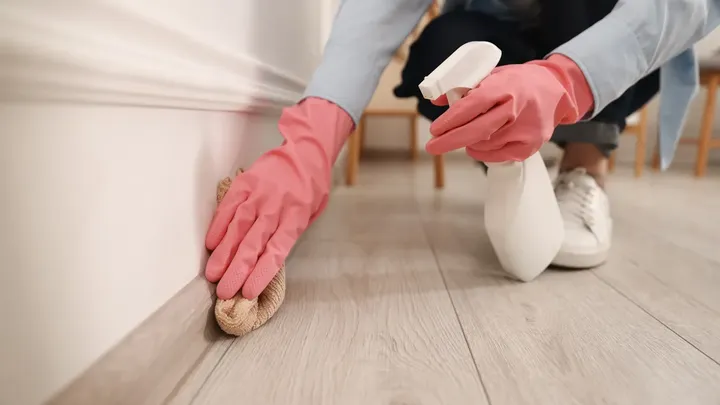
The skirting boards are the job many people leave until last before visitors arrive. After all, cleaning them usually means getting down on your knees, dragging a bucket around the room and bending into awkward corners.
But cleaning professionals say there's an easier way. The trick is knowing which tool to use and why you shouldn't get your skirting boards too wet.
Why cleaning skirting boards can be hard on your knees and back
Spending a long time kneeling or bending forward can put considerable strain on your body, particularly if you already have stiff joints or back problems.
The US National Institute for Occupational Safety and Health (NIOSH) identifies repeated kneeling, stooping and awkward positions as risk factors for work-related muscle and joint problems.
Although its guidance focuses on workers, the principle applies to household cleaning too: reducing prolonged awkward positions can make physical tasks more manageable.
That's where a long-handled cleaning tool comes in.
Step one: Remove dust without bending down
Before reaching for water or cleaning products, start with a dry clean.
The easiest method is to take a clean broom and gently run its bristles along the skirting boards. Pay particular attention to the top edge, where dust and pet hair often accumulate.
Alternatively, use a vacuum cleaner with a soft brush attachment and an extension tube.
An ordinary broom and a microfibre cloth attached to a long handle can do much of the work while you're standing up. Professional cleaners also recommend flat mops.
If you have an extendable microfibre duster, that works too. Its soft fibres can collect dust without scratching painted surfaces. Professional cleaner Penny Nicholas, founder of Sparkling Penny, recommends a mop with a microfibre head in Homes & Gardens.
The important part is removing loose dust first. Otherwise, adding water can turn it into dirty streaks.
Step two: Use a flat mop for stubborn dirt
If your skirting boards still look grey after dusting, it's time for a gentle wipe.
Mix a few drops of washing-up liquid with warm water. Lightly dampen a microfibre cloth, then attach it securely to a broom handle or use a flat mop with a washable microfibre pad.
Run the cloth along the boards in smooth, horizontal strokes.
One important tip: spray the cloth or mop pad, not the skirting board itself. This helps prevent water from running into gaps along the floor.
Replace the cloth when it becomes dirty, and finish with a dry pad.
For greasy kitchen skirting boards, some cleaners suggest diluted vinegar. However, vinegar can affect certain paints and finishes, so mild soapy water is generally the safer starting point. Always test an inconspicuous area first.
The unusual paint roller trick
Here's a method you might not have considered.
Cleaning website The Clean Tips recommends attaching a clean, short-pile paint roller to an extension pole.
According to the website, the roller's fibres can reach the narrow top edge of the skirting board, where a regular mop sometimes struggles.
Start with a clean, dry roller to collect dust. If the surface needs washing, use a separate, very lightly dampened sleeve.
There are limitations, though. Decorative skirting boards, tight corners and intricate grooves may still need a smaller brush or cloth.
This is a cleaning tip from one website, rather than a method independently proven to work better than a microfibre mop.
Be especially careful with MDF skirting boards
Not all skirting boards tolerate moisture equally well.
Many modern homes have MDF skirting boards, which can swell when water penetrates damaged paint, joints or exposed edges.
Dutch skirting-board supplier TipTop Plinten warns that prolonged moisture exposure can cause MDF to expand.
That's why you should never soak these boards or leave water sitting along their bottom edges.
Use a barely damp cloth and dry the surface immediately afterwards. The same cautious approach is sensible for painted wood.
How often should you clean them?
You don't need to repeat the entire process every week.
The Home Depot recommends dusting skirting boards about once a month and wiping them with a damp cloth roughly every two months. Homes with pets may need more frequent attention.
Before Christmas visitors arrive, start with the living room, hallway and guest bedroom.
And remember: you probably already own everything you need. A broom, an old microfibre cloth and a long handle can make this overlooked cleaning job much easier on your knees.