
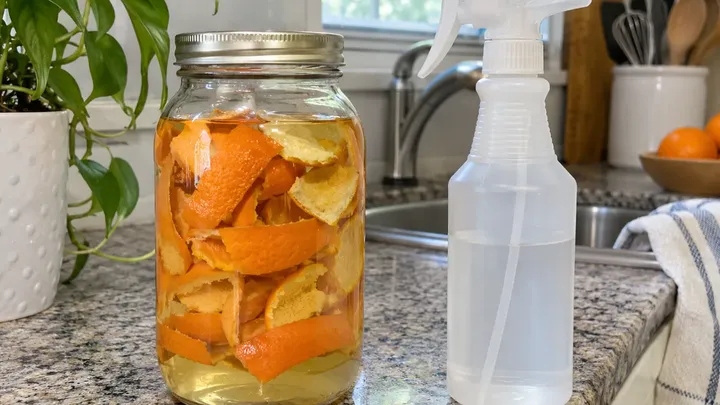
November is the time of year when mandarins and clementines start filling fruit bowls again. After eating the fruit, most people throw the peels straight into the trash. But an old household trick, now making the rounds in Spain, gives those leftover peels another use.
The idea is to make an easy homemade cleaning spray that smells more pleasant than ordinary vinegar.
There's one important catch, though. While this mixture can be useful around the house, it can permanently damage certain countertops, floors, and bathroom fixtures.
How to make the citrus vinegar cleaner
You don't need any special ingredients or expensive equipment. A glass jar, leftover citrus peels, distilled white vinegar, and an empty spray bottle are enough. Mandarin, orange, lemon, lime, grapefruit, and clementine peels work too, and you can even combine different citrus fruits in the same jar.
Here's how to make it:
- Collect the peels. Rinse your mandarins or oranges before peeling, and put the leftover skin into a clean glass jar.
- Add vinegar. Pour in enough ordinary 5% distilled white vinegar to cover the peels completely.
- Leave it for two weeks. Close the jar and store it in a cool cupboard, away from direct sunlight.
- Strain and dilute. Remove the peels using a fine sieve. Mix one part infused vinegar with one part water in a clean spray bottle.
This method is also described by Stevie Storck, who recommends letting the peels soak for one to three weeks.
Label the jar clearly and keep it somewhere children cannot reach.
Why add mandarin peels to vinegar?
Anyone who has cleaned with vinegar knows its sharp, sour smell. Soaking citrus peels in it can soften that odor, although it won't eliminate it entirely.
Citrus peels also contain natural aromatic oils, including limonene, which has grease-dissolving properties.
But that doesn't mean the homemade mixture is automatically better than ordinary vinegar. There's no good evidence that soaking peels for two weeks makes the finished spray significantly more effective.
The vinegar itself remains useful for tackling certain mineral deposits, including light limescale on suitable surfaces.
Where can you safely use it?
The diluted mixture can be used to clean glass, certain plastic surfaces, and some glazed ceramic tiles.
For everyday cleaning, spray a little onto a cloth rather than directly onto the surface. Wipe the area, rinse with clean water where appropriate, and dry it afterward.
Always check the manufacturer's cleaning instructions first, particularly on appliances and coated surfaces.
Remember that homemade citrus vinegar is a household cleaner, but not a proven disinfectant. It shouldn't replace an approved disinfectant when proper disinfection is necessary.
Never use this mixture on these countertops
This is where the popular trick can become expensive.
According to the Natural Stone Institute, acidic substances such as vinegar and lemon can dull or etch certain natural stones.
Marble, limestone, and travertine are particularly vulnerable. Even a brief exposure may leave cloudy patches that ordinary cleaning cannot remove. Terrazzo containing marble or limestone can also be affected.
Granite is generally more resistant, but acidic cleaners are still best avoided unless the stone supplier specifically approves them.
There's another surface to watch: your faucets. Bathroom manufacturers advise against vinegar-based cleaners because they can damage metal finishes and components.
One more safety rule: never combine vinegar with bleach or chlorine-based cleaning products. According to the CDC, this combination can release dangerous chlorine gas.
A useful trick, as long as you know its limits
With mandarins and clementines coming into season, collecting a handful of peels is easy. Instead of throwing them away, you can turn them into a pleasantly scented cleaner using something already in your kitchen cupboard.
Just remember that natural doesn't automatically mean safe for every surface. Keep the spray away from natural stone and sensitive fixtures, and this simple household trick can be a useful way to give citrus peels a second life.